


Music to Everyone’s Ears?
Riverfront Park Amphitheater Splits Opinions Between Businesses and Residents
By: Evan Gates
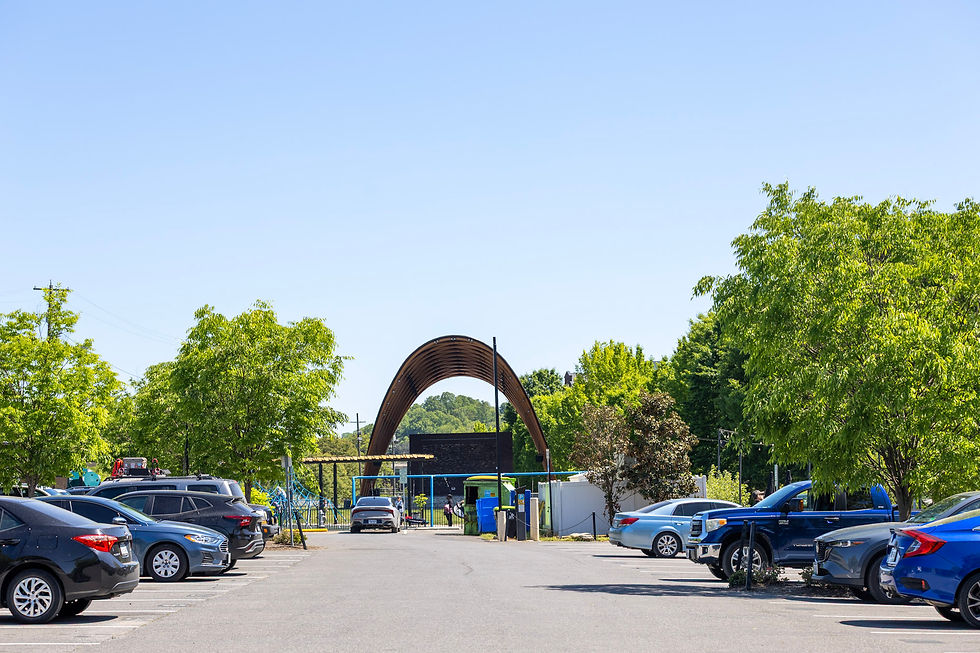
A public parking lot neighbors Lynchburg’s Riverfront Park Amphitheater, which opened in April 2026. Photo by Nick Brent.
Lynchburg, Va. – As the Riverfront Park Amphitheater transitioned from a blueprint to the City of Lynchburg’s newest music venue, neighboring business owner Dave Henderson surveyed the sunlit lawn with a smile. Throughout the same Friday evening, many downtown residents felt lost in the shadows.
Entering its inaugural season, the Riverfront Park Amphitheater’s objective to unite the community and generate local business revenue was eclipsed by the parking concerns of downtown residents.
Located in Riverfront Park on Jefferson Street, the outdoor facility began as a drawing in the Downtown 2040 Plan, a revitalization plan for the city’s future. For Henderson, who opened his restaurant The Water Dog in 2016, the venue is a testament to the city’s vision for growth.
“This isn’t just a music venue; this is a statement about how we perceive Lynchburg and how we are investing in Lynchburg’s future,” Henderson said. “It will benefit the community well beyond the voice of a singer, but further into community development. It’s another feather in the city’s cap for unique, family-friendly experiences.”
In October 2025, the city selected Mason Lane Entertainment to serve as the venue’s operator and schedule acts to perform at the amphitheater. With the facility originally scheduled to host 10-20 weekends per year, between concerts, festivals and other events, Henderson believed the amphitheater marked progress within the Riverfront renovation efforts.
“Over the last 15 years, the city has made some really smart and wise investments in its infrastructure downtown, but I don’t think we’re there yet,” Henderson said. “There are still vacant storefronts, there are still parts of downtown with worn-down buildings that need to be fixed up.”

While Jefferson Street experienced steady progression within the recent decade, the remainder of downtown has lacked variety, according to residents. One noticeable listed shortcoming is the lack of grocery options for residents. Graphic by Evan Gates.
As businesses boomed on Jefferson Street within the past decade, downtown tenants underscored the run-down buildings and lack of parking improvements in other areas. Jefferson Street resident Pat Young believes that the city’s direction signaled a disconnect between residents and City Hall.
“When I think about the city, it does not reflect a vibrant community,” Young said. “Main Street looks so tired and buildings are dilapidated. I don’t recall any communication [from the city], even prior to the beginning.”
In addition, many Jefferson Street residents spent years sharing their parking lots with the public. While the city confirmed having over 6,000 public and private spaces available for public use amidst the preparations, locals voiced concerns about losing their nearby spots.
“After 5:00 p.m., it’s free parking,” said resident Robert Canida. “Although we pay for a spot on a certain floor, it’s not a designated spot, so anyone can come and take it. It’s part of downtown living.”
As the sun set on the amphitheater’s construction process, residents were just awakening to new concerns about the Riverfront’s new decoration.
I. With High Budgets Come High Expectations

In stark contrast to initial blueprints shown above, the Riverfront Park Amphitheater features a grass lawn for concert fans, while the park remains accessible to the public throughout the week. Photo from Lynchburg Downtown 2040 Plan.
In the earliest days of the project, Deputy Director of Public Works Clay Simmons embraced Rivermont Park's growth from a temporary stage to a firmly established facility, even if it meant expanding the budget.
In a November 2023 work session, the Lynchburg City Council amended the project budget by over $3 million to accommodate Jamerson-Lewis Construction’s bid of almost $8 million, as the city couldn’t cut costs without eliminating the park’s public restrooms. For Simmons, the hefty investment would be validated in the long haul through the amphitheater’s consistent schedule.
“Before, we had a tow-around stage that Public Works was the caretaker of,” Simmons said. “Clearly, it had its limitations. [The amphitheater] is going to be activated a lot more frequently, we hope.”
The new permanent structure featured a curved steel design, unlike other projects of the past. In collaboration with Shickel Corporation, a metal fabrication company in Bridgewater, Va., Jamerson-Lewis exceeded the City’s expectations in its swift execution.
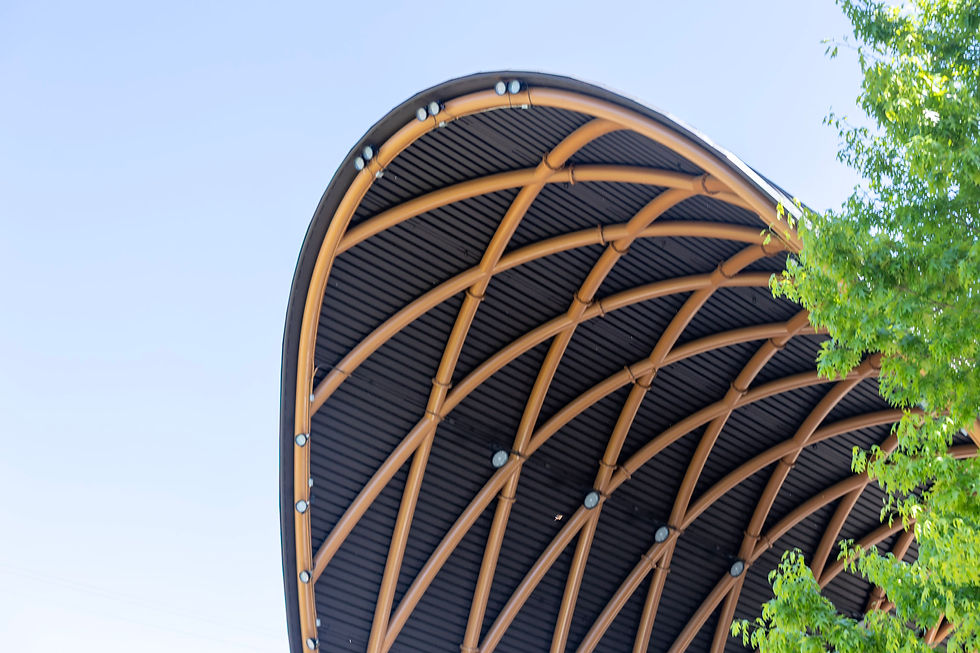
The structure’s curved design is intended to assist the acoustics by directing sound towards the crowd. Photo by Nick Brent.
“We were told to expect at least six to eight weeks for the steel assembly, and they were done in eight days,” Simmons said. “The structure really just fell together, and it had never been assembled prior to that. That spoke to [Jamerson-Lewis’s] talent.”
Months later, the amphitheater hosted its first community concert just two years removed from the beginning of the construction process in April 2024. As future events arose, the city pledged to maintain Riverfront Park’s identity as a public space, despite its activation by a private company.
“If citizens see anything with the facility that’s an issue, their first stop should be the city,” Simmons said. “We’re still going to be maintaining the facility.”
Although taxes would assist in recovering the construction funds, the city relied on its tourism efforts to lessen the load on residents. According to the aforementioned November 2023 project update, the City Council listed its hotel, meals and admissions taxes as an efficient method for generating revenue.
To contrast with many residents’ frustrations with the project, Robert Canida welcomed the connection between tourism and local businesses.
“More folks, more business, more revenue,” Canida said. “I think it’s going to be a win-win for folks, and if they want to go downtown, they’re going to find a place to park. I just hope the business owners on Jefferson Street and Main Street are preparing themselves for the summer.”
II. Rising Tides Lift All Ships

The Water Dog overlooks the amphitheater’s lawn, while customers can watch the shows from the restaurant patio. Photo by Nick Brent.
While Henderson prepared the possibilities of lively concerts in the lawn adjacent to The Water Dog, he understood the need to make adjustments throughout the opening weeks.
Despite the prospect of generating increased revenue on event nights, businesses throughout Downtown Lynchburg began shifting strategies to complement, rather than compete, with the amphitheater.
“Much like the amphitheater, we will figure it out after a couple shows,” Henderson said. “For as much planning as we’ve done and will continue to do, we’ll also bump into some walls and have to figure it out along the way.”
Henderson’s objective, as the next-door neighbor, focused on shifting the business model to ensure customers can eat in a timely fashion. The task also meant finding ways to ensure the restaurant’s patio is available for paying customers, rather than being occupied by squatters for the concert.
“We’re so lucky that our patio and restaurant is just adjacent to the amphitheater and the park; we need to shift our model to handle that,” Henderson said. “If there are potentially hundreds of people who are hungry and have watched a show all day, we need to be able to turn and burn.”
Owning a staple restaurant on Jefferson Street, Henderson also believes that it will be critical to maintain his brand’s core identity and customer base during a time of transition.
“I don’t want my regulars to feel like they’re not welcome on some of the more special days of the year,” Henderson said. “We’ve just got to figure out what makes the most sense for the business in terms of profitability, while staying true to who we are.”
The business collaboration also extended into the arts scene, as other music venues have attempted to flex their shows to promote the amphitheater’s events. At the Academy Center of the Arts, Head of Operations Tabitha Abbott believes there are more possibilities than problems.
“At the end of the day, we are firm believers that the more happening downtown from an artistic perspective, the better,” Abbott said. “We don’t see any real threat having the amphitheater there; we just want to pay attention and coordinate to make sure we’re not booking the exact same genre on the same night.”
For both Henderson and Abbott, the organization process involved having conversations with Ty McBride, who serves as the President of Mason Lane Entertainment. At the Academy, which hosts youth camps throughout the summer concert season, few sacrifices had to be made to match the amphitheater’s schedule.
“It works out well for us because our heaviest program months of the year are always during the spring and the fall,” Abbott said. “That might organically benefit the structure that the amphitheater has.”
On the contrary, finding ways to maintain regular customers on concert nights became a perplexing scenario for downtown businesses. With limited adjacent parking space and road closures, The Water Dog focused on ensuring that loyal customers still feel welcome.
“I hope through our service that people don’t get confused or thrown off, thinking that we’ve changed who we are because there’s an extraordinary event here,” Henderson said. “I just hope our identity continues to show.”
III. To Park or Not to Park?

At highly attended events, a free shuttling service will operate on the pink loop shown above to transport crowds up the hill. Map by the City of Lynchburg.
As businesses struggled to ensure nearby parking for customers, local residents also faced the potential hurdles of losing their normal spots and encountering prolonged traffic on Jefferson Street.
Beyond the 4,100 privately owned parking spaces in downtown Lynchburg, the City boasted approximately 1,000 public spots for long visits and blocked off several for handicap access. For lots by the riverfront, several spaces would be shared between businesses and patrons of the amphitheater.
“I don’t see these parking lots as the Water Dog’s; it is a community asset,” Henderson said. I know this is going to be a disruptor for everyone, not just us, so we are in it together. If our regulars’ migration patterns shift on concert days, I hope those customers understand that this isn’t something we’ve done intentionally.”
While the amphitheater could hold up to 5,000 fans, many residents felt apprehensive about locating nearby lots. In addition to Riverfront Park’s parking map, Interim Director of Public Information Susan Brown believes this project will promote new ways of traveling downtown.
“You’re adding in new options of ride-sharing apps and riding together,” Brown said. “Plus, there are privately owned lots which, if they choose to participate and charge a fee, will be promoted.”
Furthermore, the City of Lynchburg announced plans to offer a free shuttling service for highly attended events. Rather than escorting fans to parking areas outside the downtown area, the shuttle route looped through Commerce Street and Church Street to promote local businesses.
“We’re making sure that it’s not feeling like we’re ostracizing all of our other entertainment arenas and avenues,” Brown said. “The goal is to enjoy a walkable city where you can find ways to stay, and it’s not always about paying exorbitantly.”
While out-of-town visitors crowd downtown, however, many local residents began voicing frustrations about their spots being displaced on concert nights. Pat Young believes routines will look vastly different during event nights.
“If you’re coming home with a bunch of groceries or lugging a suitcase, the parking is atrocious in that area,” Young said. “If I were the planners, something’s going to have to give.”
Lynchburg’s largest parking garage, the Midtown Deck, houses 428 spaces. For comparison, the Elmwood Park Garage in Roanoke, Va., which sits adjacent to the Elmwood Park Amphitheater, owns 628 spots for concertgoers.
During the time of transition, Young wishes for a stronger distinction between event lots and residential spaces.
“Spaces should be blocked off for those residents, which is not what they’re going to do because they want concert-goers to have front row parking,” Young explained.
While hauling groceries can be a minor annoyance, Young sees the issue as a microcosm for a disconnect between the city and many downtown residents.
“Is there value being placed on the residents who live there?” Young said. “A concert is going to bring in hundreds of thousands of dollars on a weekend, but the people who are living there day in and day out aren’t your primary users of services in the downtown area. Where is there empathy for that?”
IV. Who Determines the Barometer for Success?

Several apartments border Jefferson Street and the amphitheater, while others are tucked away on the hills. Photo by Nick Brent.
As city workers and downtown residents maneuver the amphitheater’s first concert season, both parties believe that adjusting to change can be a lengthy process. The city, however, hopes that residents can still access their favorite locations, despite having to rearrange plans.
“Don’t take this as an opportunity to say, ‘I’m not going downtown at all,’” Susan Brown said. “Just think, ‘Maybe I won’t go on Friday night, but I’ll visit my favorite restaurant on Saturday night.’”
Click the photo for an interactive experience to plan an adventure following the amphitheater construction project. Game created by Evan Gates.
With nine already scheduled events for the 2026 summer, both residents and city employees will make adjustments in the opening months. Even through the venue’s logistical roadblocks, many Lynchburg natives feel intrigued to experience it firsthand.
“I’m a patron of the Academy already, and I’m really excited about what the amphitheater might bring,” Pat Young said. “They’ve done a beautiful job in terms of the architecture. If there is a good show, I would stay on the weekends to go to it.”
While opinions about Lynchburg’s downtown future remain widely divided, progress towards a united solution will only commence once conversations between the city and its residents commence.
“I hope that everything comes together and we’re able to function as a downtown entity, where everyone feels like they’re being heard and valued,” Robert Canida said. “We put our best foot forward in building up Lynchburg for the future.”
###
To view a complimentary photo story, click here.


Comments